I’ve decided to make this Sunday Beehiv about two issues. Both of which are around current affairs public disclosure issues. I apologize for the length being over 2,700 words but both issues are complex & timely as they help explain the duty to document in crisis.
The first is Friday, August 7’s legal hearings regarding the public investment disclosure litigation previously covered. Both hearings resolved the issue. However to allow readers to hear both pro & con, long statements were blockquoted as one will read.
The second topic is what I could find - and not find - regarding the December 2025 no-fly zone over part of Skagit County. The decision to push publication to now is due to sadly similar drone interference with first responders in Spokane County with the historic arson-set wildfires fueled in part by climate change as former Governor Jay Inslee bravely explained on X. I also note a substantail amount of time was needed for Skagit County Government’s public records division to get these documents back to me.
However, I’ve felt for some time that this Beehiv needs to be not just telling that public records help with accurate journalism… but show how public records enable accurate journalism. The problem is correctness.
Intended Publishing Schedule
For those who like to know what’s coming, here’s the intended publishing schedule. Please note repeated usage of the word intended.
Next Sunday the 16th is the monthly editorial, which likely will be a full-throated Jamie Nixon-style defense of the Public Disclosure Commission.
The following Sunday the 23rd will focus on the BC Information & Privacy Commissioner’s 2025-2026 annual report as previously pledged.
August 30th is intended to be about ferries… partially based on Washington State legislative public records.
September 6th is intended to be about the Attorney General’s Office Model Rules - and comments into them. A good “back to school” Beehiv.
Obviously, events and interview opportunities can - and do - happen to be weaved into the publishing schedule. Of course, if anything major breaks in the House Press Pass Saga - I’ll bring that to you.
Of PIIDs and Public Disclosure
Friday, August 7 in Thurston County Court had a dramatic but not rude exchange of arguments between Arthur West and Judge Chris Lanese. I will attempt to give some history and then discuss what was said in court as well as show both the blue team pontification and the red team rants.
First, An Acute PIID History
Judge Lanese’s defense of the Public Investment Impact Disclosure arguably gives me flashbacks to 2019 when Anna Zivarts confronted Tim Eyman over the harms his initiatives have caused transit-dependent folk like the author.
Arguably, that exchange contributed to the efforts to place a Public Investment Impact Disclosure law into place in 2022. I also quote the legislative declaration of RCW 29A.72.027, that states,
"The legislature recognizes that the people have reserved for themselves the power to enact or reject legislation through the initiative and referendum process, as provided in Article II, section 1 of the state Constitution. The legislature finds that when exercising this right, the people are entitled to know the fiscal impact that their vote will have on public investments at the time they cast their ballots. The legislature further finds that when a ballot measure will affect funding for public investments, a neutral, nonprejudicial disclosure of the public investments affected will provide greater transparency and necessary information for voters."
Northwest Progressive Institute polling back in March 2022 showed 82% of votters supported this law. With that…
Arthur West Challenges the PIID on August 7, 2026
That law was challenged by someone in Arthur West who is a constructive skeptic of government and represented himself pro se. One can read an excellent Seattle Times summary or watch the proceeding thanks to TVW:
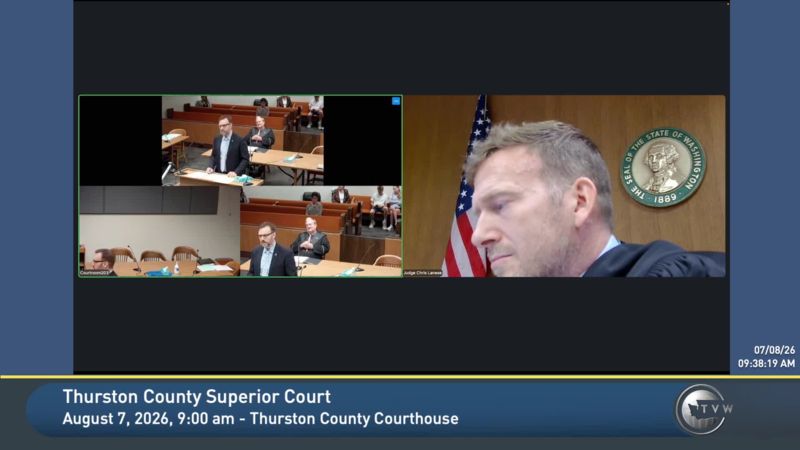
Most of West’s argument was that the PIID was unnecessary as a law. Best shown by the below polemic quote:
The only thing the PIID adds is a shorter, more alarming, gypsy fortune teller-like misleading prediction, a place where it will have the maximum partisan electoral effect.
The Northwest Progressive Institute wrote a long piece laying out what happened and the implications for the political left. In that piece was this quote from Judge Chris Lanese in response to Mr. West:
Aren’t initiatives that seek to reduce taxes without any reference to the impacts of that not neutral themselves? No one wants to pay taxes, right? But if we all just pretend we don’t have to reduce any services as a result of those cut taxes, isn’t that not neutral? Isn’t that only showing half the picture to voters? Isn’t identifying what’s going to be cut what’s making it neutral in the end, because it shows both sides of the ledger?
Deputy Solicitor General Karl Smith clapped back at court with,
Hiding information about the fiscal consequences of an initiative that people are entitled to see on the ballot is not equitable. … This isn't regulating private speech in any way. This is strictly government speech.
Deputy Solicitor General Smith also responded to arguments made in court by Arthur West - and later that day Brian Heywood on X - that the voter’s pamphlet was sufficient by stating not everyone reads the voter’s pamphlet.
In a verbose ruling, Judge Lanese made clear the PIID is part of the laws supporting the initiative process. The PIID does not stop initiative signature gathering nor voting on an initiative as West alleged. Instead, as Judge Lanese explained,
There's an argument to be made that if ever we have to think about cut spending or less likely to vote for tax cuts, we have a legislature who legislates by looking at the whole picture. It is far from unconstitutional that we force voters to think about the same thing. There's nothing that's un-neutral or that is biased about that, and so there is that. Nothing is unconstitutional about this statute on its face.
In conclusion, one could argue that West’s litigation was so disruptive and possibly untimely in deciding to target the PIID RCW instead of IP26-675’s specific PIID that West’s litigation clouded up the issue so many on Washington’s right are concerned about - whether the PIID the Attorney General’s Office issued for IP26-675 is an accurate representation of what IP26-675 does. Reading responses from conservative voices like Brian Heywood and the Project 42 communications consultant + vodcaster Brandi Kruse encapsulated on one X thread as well as the Washington Policy Center’s fumigation helped propel this conclusion.
Round II With Superior Court Judge Anne Egeler
But wait. As TVW covered, there was a second and separate hearing about IP26-675’s PIID. This hearing was also thankfully on TVW. Judge Egeler heard arguments from both sides, and without the, er, dramatic flourishes of Judge Lanese, ruled the following way,
The explanatory statement prepared by the Attorney General accurately states the law as it currently exists and the effect of measure if it becomes law. The tax on millionaires does not control appropriations from the general fund. … In explaining the law as it presently exists, I do agree with petitioners that the listing of tax preferences could be somewhat more accurate and easier for voters. … At page 9 of the Attorney General's brief, the AGO has offered an alternative last paragraph for this section addressing the law as it presently exists. This alternative categorizes the taxes in a way that is easier to understand and includes mention of the wholesales food sales without erroneously suggesting that appropriations from the general fund have already been fixed. Therefore, the alternative paragraph offered by the AGO will be applied.
Finally, this section of the statement addressing the effect of the proposed measure, if approved, is an appropriately neutral and accurate statement. It correctly indicates that the tax preferences listed in the section addressing the law as it presently exists would not be repealed by the measure.
Of course, it would be helpful if all Washington State court filings were… online and downloadable for free.
No on 645 Response
As No on 645 spokesperson Erik Houser shared with the Northwest Progressive Institute,
“As recognized by the judge’s ruling, it is the law in Washington to provide a short, factually accurate, and neutrally-worded fiscal impact statement on the ballot about the effect of initiatives like this, and the effort by initiative proponents to remove it has no constitutional merit. The judge further affirmed that the wording of the PIID is neutral and accurate. This is a win for voters and the public because the PIID statement gives voters important information they can – and likely will – take into consideration when making a decision about how they will vote on the measure.”
“The reason Brian Heywood and I‑645 proponents challenged the PIID statement is because they know that voters in Washington care about critical services like K‑12 education, health care, and child care, and don’t want to see those services get slashed. Heywood knows that if voters take into consideration the cuts to public services that will result if his measure passes they will turn against his effort to repeal the Millionaire’s Tax, which is why he tried and failed to game the PIID language. With the PIID and ballot title language now finalized, we are confident that the public will see Heywood’s measure for the selfish self-enrichment scheme it is and will vote no in November.”
We’ll let the statement speak for itself. Now we turn to I-645 author Brian Heywood for balance.
Reviewing the (Political) Right Response
Reviewing Heywood’s aforementioned long post on X, one should note that Heywood pointed out,
He [Judge Egeler] exposed his bias in the earlier case when he called tax-cut initiatives "not neutral" and blamed budget gaps on people who don't want to pay taxes. Except I-26-645 cuts no appropriation. The tax it repeals generates zero revenue until 2029. State spending is up 55% after inflation and population growth, and lawmakers just passed the two largest tax increases in state history.
Also Heywood did note:
Oh and just a reminder, this same judge who essentially gave a stranger standing in our case regarding the financial impact statement just happens to be the very same judge who denied @WAPolicyGreen Todd Myers standing when he petitioned the department of ecology to release their carbon reduction numbers to the citizens of the state as they are required by law.
In a separate X post, Heywood then piled on saying,
An activist Judge allowed a non related case to be expanded to a cover our challenge. An unrelated party was given standing by a judge (famous for not giving standing to citizens agains the state) to argue his interpretation of our case. And then the judge preemptively eliminated any chance we had to be heard in court.
I’m sure anyone who supports open government thinks we have problem stacked on top of problem for the open government community here. Even if you believe in the Climate Commitment Act (CCA) and appreciate the CCA’s contributions to say… your local transit agency.
The Last Word
On this subject, the last word should go to Deputy Solicitor General Smith from the first case:
Here, the objective is an informed electorate. That's accomplished by putting the public investment impact disclosure somewhere that all voters will see it when engaging in the act of lawmaking and deciding whether to approve a law. … The public investment impact disclosure just gives the voters relevant information. There's nothing unconstitutional about presenting voters with more information, and that's all the public investment disclosure does here.
To me, although the PIID for IP26-675 was phraised incorrectly to me, the virtues of the PIID are clear. The public when voting truly needs to know the fiscal impacts of direct democratic measures such as initiatives.
Explaining a Temporary Flight Restriction (TFR)
While transitioning to review the creation and use of temporary flight restrictions (TFRs) as was originally planned for today, it’s important to explain what a TFR is. A TFR is a limit on the use of federally regulated airspace placed by the Federal Aviation Administration (FAA). TFRs are for instance placed around stadiums for sporting matches and political conventions as drones are not always, well, used for peaceful purposes such as aerial photography. Drones have become weapons of choice - such as in Ukraine.
Disclaimers
Should add I am a FAA Part 107 drone pilot open to doing commercial work with my drone. However, I am not a FAA instructor nor a lawyer.
Also, I’ve decided to edit out names. I’m just not that comfortable making this, well, personal. This shoud be about the policies not the personalities.
Why TFRs for Disasters?
Additionally, drones can - and do - cause airspace conflicts. Although drones are at the bottom of the airspace totem pole and must give way to other aircraft, a significant handful of reckless drone pilots do not operate safely. For instance, Spokane County in Eastern Washington is at the business end of such activity as per this KREM 2 report:
There is also this KIRO Newsradio short with an actual aerial firefighter:
I have a public records request for the Spokane County Sheriff’s Department incident reports about drones between July 24 and August 7 as it appears the Spokane County Sheriff’s Department is the lead agency in responding. Don’t worry about pulling away from firefighting, sheriffs’ departments have dedicated public records officers.
So What Did I Find About Skagit’s December TFR?
With that, sadly, no detailed discussion of who called for the TFR and other details. I did get records about the public relations, er, outreach why the TFR for Skagit County. Records like the below MS Teams chat:

There was also several mentions in the documentation that the Washington (Army) National Guard had a UH-60 Blackhawk doing aerial recon patrols in the TFR zone between Sedro-Woolley and Concrete. A UH-60 like if not the one pictured below:

Photo: Staff Sgt. Adeline Witherspoon, Joint Force Headquarters - Washington National Guard
There was seemingly a real concern that drone pilots who have a tendency of flying beyond visual range of sight and have minimal situational awareness while… spectating Mother Nature at work could have collided not just with the reconniasance helicopter but the other helicopters hard at work responding to the situation. Other helicopters called in included NAS Whidbey Island’s Island Angels Search & Rescue (SAR) Squadron but also a Chinook helicopter, other H-60s from the National Guard, two Washington Department of Natural Resources (DNR) renovated UH-1H Hueys, and even two Coast Guard helicopters staged in Bellingham and Arlington.
During the Search for Records…
Worth noting that Skagit County Government on February 28 and March 1 did a search for records about the “temporary flight restriction”. This is what I got, after noting I whited out the name of the public servant as a courtesy:

Skagit County Government search log
Concluding Thoughts: About the Duty to Document
One of the lessons of this exercise is arguably Skagit County Government in an emergency fell short of the duty to document. Nobody knows how the decision for a TFR came about in the heat of a natural disaster, the TFR was just dropped to protect a UH-60 Blackhawk and other rescue helicopters without evidence of drone interference. Of course, this December 2025 decision is being reviewed in the context of August 2026 where there has been alleged - and likely documented - drone interference with aerial firefighting operations. Hence this editorial cartoon:

“Duty to Document” Editorial Cartoon
At least with the PIID previously discussed, there is an attempt to meet the duty to document the fiscal impacts of ballot measures. However, the Republican retorts to the concept of a PIID belie a lack of ideological commitment to the duty to document.
Ultimately, as a previous British Columbia Information & Privacy Commissioner in Elizabeth Denham wrote in 2016,
By creating records that explain the ‘what’ and ‘why’ of public agency decision making, a duty to document promotes accountability, transparency, good governance and public trust.
Commish Denham gets the last word…